PCS Union wins historic legal battle

News broke on 20 November confirming that PCS had won a 10 year long legal battle against a decision of the then Coalition Government to withdraw the check off method whereby Union members subs were deducted directly from their pay by the employer. The full story can be read here.

https://www.pcs.org.uk/news-events/news/pcs-wins-historic-battle-against-government-departments-supreme-court

The significance of this victory should not be underestimated. Although a legal victory it was the result of a united and determined campaign by members and activists and the union leadership, first under General Secretary Mark Serwotka and latterly his successor Fran Heathcote.

This case arose from the Tory/Lib Dem government’s attempt to bankrupt and break PCS, an attack that continued for years, and which the Union defeated, emerging stronger.    

The attack was political and carried out because the Union refused to bow down to the pensions sellout of 2011-12 and continued to fight on industrially, and also because it advocated not just resistance but a political alternative to Austerity.  

The campaign over many years of painstaking work from reps and members from all corners of the Union was a model in Union Organising. Many elements of this were soon taken up by other Unions in their organising work.  

The legal strategy is never an easy option to pursue. Court judgements are rarely in favour of Trade Unions and workers. Under the direction of senior officer Paul O’Connor though a long and hard legal battle has been comprehensively won.

Accompanying the attack on Check Off payments were attacks on Trade Union facility time for our reps particularly time off to attend Union Conferences and for Organising work. Undeterred many of our reps simply continued with these activities in their own time and using their annual leave.  

In 2014 a secret “Union busting in HMRC” document, leaked to PCS, also emerged which prepared and carried out the complete withdrawal without notice of all facility time off for seven leading activists in the Group including the Group President Lorna Merry and national Vice President Kevin McHugh. Through the work of reps on the ground in HMRC Group with support from the National Union that attack was successfully repelled along with short lived attempts to build a scab breakaway Union in that Department.  

We won’t be returning to the Check Off system but should be due significant compensation of millions of pounds from this Supreme Court judgement. Following a previous successful legal judgement against the DWP, the NEC at the time put most of this money into the Fighting Fund which laid the financial foundations for supporting members taking paid targeted Industrial Action in the first phase of our National Campaign at the end of 2022.  

Under the strategic leadership and direction of a Democracy Alliance led NEC together with the efforts and determination of our staff and all of our reps this is a success story for our Union in which we can all take pride.   

Left Unity support the G4S strikes

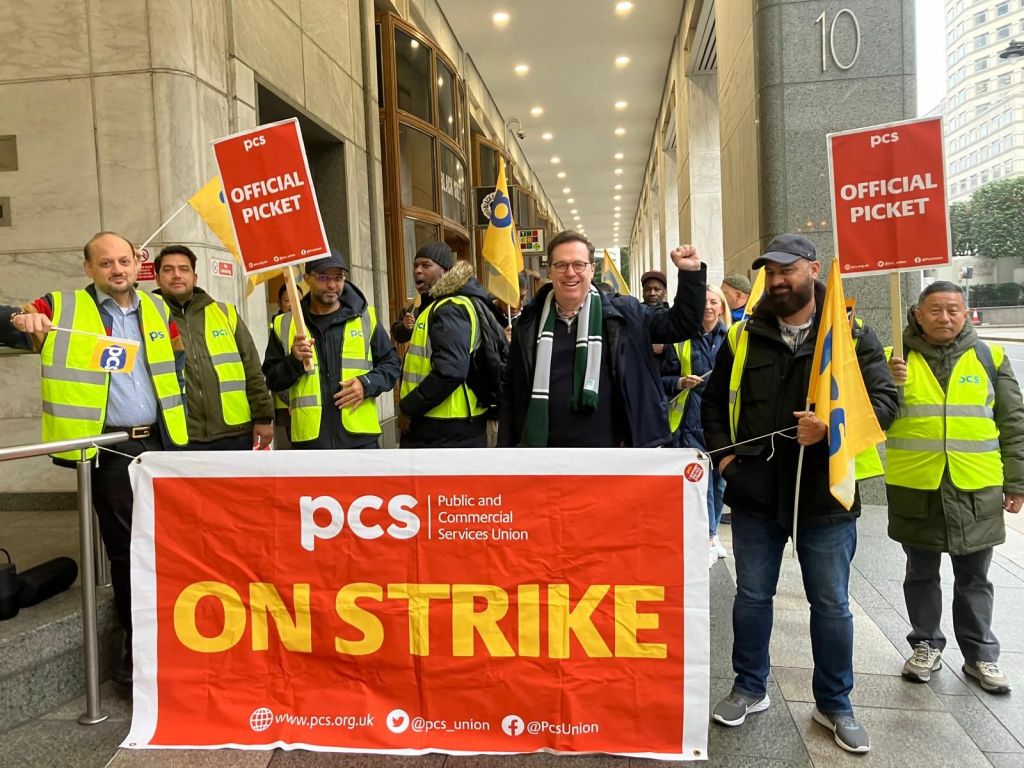
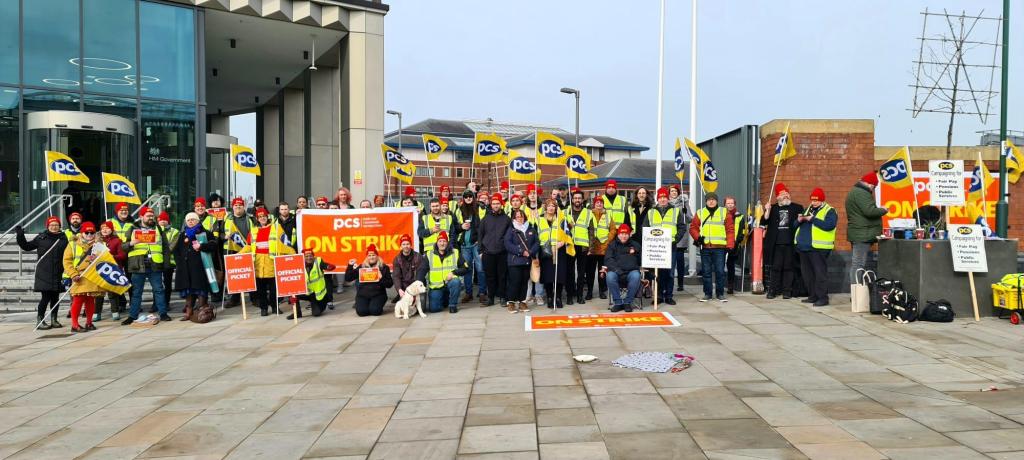
Between 28th October and 12th November, I supported the PCS members of the security officers on Strike against G4S.

Their last pay offer was an insulting 32 pence per hour above the national living wage with, hardly, any sick pay. But it did not prevent them from voting by 84% to reject the pay offer, and by 89% for more strike action.

The workers have, already, taken 41 days strike action in their dispute, resulting in jobcentres being closed and a reduced service being offered in others.

In London, I supported numerous amazing picket lines outside the Cabinet Office, South Colonnade Building in Canary Wharf and 10 Victoria Street.

I had to rise at 5.30 am each morning and travel down to the picket lines from Potters Bar in Hertfordshire, before starting work.

The attendance outside the Cabinet Office was enormous and solid with plenty of loud music, blowing of whistles and dancing.

We had support from quite a few Labour MPs including John McDonnell, the Labour MP and former Chair of the PCS Parliamentary Committee who condemned the appalling way that the security officers had been treated by the government according to their pay, terms and conditions, especially their sick pay. He added that the new Labour government has promised in – sourcing and must do so as soon as possible.

At Canary Wharf, the picket lines were well attended. It revealed that the legacy of the camaraderie of the Dockers is alive and well of which is a great inspiration to us all!

Left Unity will continue to support the struggle of all security officers and cleaners in the commercial sector. We encourage them to be active in PCS Union at local, departmental and national level. It is Left Unity’s aim to ensure that all cleaners and security officers are adequately represented in branch, regional, group, and national executive committees.

Let us campaign to improve the pay, terms and conditions of all cleaners and security officers.

An injury to one is an injury to us all in Left Unity as well as PCS!

Solidarity

Austin Harney

Coalition of Chaos attempts to cut PCS members’ services and benefits

Supporters of the so-called “NEC Majority” attempted to pass a series of cuts to PCS budgets and services at the NEC meeting held on 7th November.

Supporters of the coalition tabled proposals to:

  • Impose real terms cuts to every budget in the union by setting a 0% increase.
  • To impose further cuts to overspent budgets including the conference budget, legal services budget, membership benefits and our benevolent fund.
  • To freeze the pay of PCS staff by setting a 0% budget increase. 
  • In language reminiscent of George Osborne the ‘NEC Majority’ attempted to force budget holders to ‘identify waste and find savings’ to budgets. 
  • Impose austerity on the union’s own budget and to tear up the financial objectives democratically agreed at ADC in May of this year.
  • Block a subscriptions increase of 17p in 2025 in favour of continuing to collect the Levy. A subs freeze will mean that we need to cut our services by £1.3M next year.

Our General Secretary, Fran Heathcote, had to intervene to prevent these cuts taking place and to move an alternative budget that was balanced, and which protected members services. A final decision will be taken on the budget at the next NEC scheduled for December.  

Left Unity members at the meeting expressed outrage and anger at the proposals, pointing out that the language being used by NEC Majority supporters used to justify their proposals was the same as that used by Tories when imposing cuts on public services and attacking PCS members.

Our supporters pointed out that a political choice to impose budget cuts would mean union services are cut. Critical budgets, including legal services, member benefits, the benevolent fund and Group and Branch funds would all need to be reduced and that funding in these areas is  already over stretched. Cutting them would be a disaster for members.    

In a rare moment of honesty, an Independent Left supporter made clear that their proposals were designed to create chaos and to attack Fran, the first woman leader of our union.

Why won’t the ‘NEC Majority’ suspend the levy?

At the same meeting Democracy Alliance members on the National Executive Committee put forward a proposal for the immediate suspension of the Levy. PCS members are currently paying £5 or £3 per month into the Levy which was devised for the National Campaign under the leadership of the Left Unity majority NEC in 2023. It was designed to support PCS members taking targeted strike action in support our demands. Over £5M was raised at that point and £6.8M paid to striking PCS members.

Our position is that, given no targeted industrial action is currently taking place or is likely to be called in the near future, that continuing to collect the Levy is ludicrous. Members and activists are quite rightly asking why money is continuing to be collected in those circumstances. 

The NEC meeting received evidence that what was once a popular method of collecting funds to support strike action in support of clear demands delivered by a clear plan is now increasingly subject to criticism from members and activists.     

Based on that evidence – and evidence from Group Executive Committees and Branches showing strong support for suspension of the Levy – Left Unity members, and our comrades in the PCS Democrats, moved to suspend the Levy with immediate effect.

We were disappointed, but not surprised, that despite winning a majority vote, the motion was blocked by supporters of the so-called NEC Majority, as there wasn’t a two-thirds majority in favour of revisiting the decision.

Unbelievably, the same people who had claimed that members could not afford a subscriptions increase of 17p were determined to continue to collect a much higher payment into a Levy that they are not intending to use.

The truth is clear

PCS members were promised a change in direction by the “Coalition” when it gained a small majority on the NEC in May.

Left Unity has consistently argued that the change that would actually be delivered would be  damaging to both the union and our members.

After a series of embarrassing u-turns since May, and the increasingly hostile and personalised attacks on our National President and General Secretary, this latest attempt to hamstring the union is surely their lowest point yet.

Left Unity will continue to demand the levy be paused, and remain totally committed to a socialist programme of building our union, and delivering for members.

We urge every activist or member of PCS, who genuinely cares about our union, to work with us to bring back some order, and place our members needs and the services we provide, at the top of our agenda.

click here to receive our WhatsApp notifications – https://chat.whatsapp.com/JTXI9Wk3cNGGuUKTFRRd2B

Where have the politics gone?

In April the coalition formed of BLN/IL/Coalition for Change supporters promised PCS members a change of approach based on more “industrial militancy” if elected with a majority to the NEC.

Some activists feared this would mean repeated calls for unpaid industrial action in accordance with their previous “strategy”, especially after the passage of Motion A315 effectively ended the coherence of the previous co-ordinated national campaign. We have not seen any industrial action called and have instead only seen chaos.

The chaos has included instructing the General Secretary to write multiple letters to the Cabinet Office without any serious tactical considerations; replacing their promised “industrial militancy“ with demands for a Special Delegate Conference of reps, rather than agree a full consultation with members – as recommended by the General Secretary; and numerous u-turns on decisions they initially made and were then forced to backtrack on in the face of the industrial reality that confronts them in leadership.

Of course, Left Unity warned that this was to be expected from an alliance formed of different political persuasions, but one that also included some people with no real politics.

Coalition of Chaos reaches new low

Rather than focus on their alleged strategy on how to win more for members and build the union, virtually every recent article written either by the “NEC Majority”, BLN, or IL, has been straight from personalisation handbook.

The content is mainly aimed at the character assassination of either the elected General Secretary, Fran Heathcote, or National President, Martin Cavanagh – the most senior elected lay representative.

Previous Left Unity articles have sought to correct some of the false narrative that has been “put to print”, but we have also set out our position on the key issues affecting members, such as the levy, which we continue to argue should be paused https://pcsleftunity.org/2024/09/16/pcs-left-unity-says-pause-the-levy-now/, and delegated pay talks, which we had to force our opponents to concede that PCS should take part in.

Sadly, over the weekend supporters of the ”NEC majority” have reached a new low.

No longer enough to create a false picture of both Fran and Martin, they have now resorted to public accusation that we cannot let go unchallenged.

The accusation that the elected General Secretary of our union has abused her position to create jobs for her friends, and in doing so placed the union’s finances in jeopardy, is beyond reprehensible.

It is bad enough to publicly make accusations that do not hold up to scrutiny, but to then encourage others to share it widely, with the clear intention of causing reputational damage is scandalous behaviour from so-called activists.

This, though, is what happens when serious trade union activism is replaced with personal grudges.

The truth

Despite what has been stated as fact in these postings the truth is very different.

It is true that the General Secretary has commissioned and subsequently conducted, a review of PCS staffing. This was reported to the NEC when it was first decided to carry out the review, earlier this year.

It is also true that the review resulted in new posts being created (23 in total), including the creation of two new Chief of Staff roles. There were other structural changes flowing from the review, including removing 22 posts that are no longer required.

The full review, which affects the staff who work for and are paid by PCS – not the elected bodies that run our union – was subject to full and open consultation with the staff’s own union, the GMB, and resulted in a collective agreement.

The review was then also presented to the Policy and Resources Committee (PRC), a senior NEC sub-committee, to whom staffing and resources matters are reported, as has been the case for the last 20 years.

It is simply untrue that there has been no consultation or scrutiny of the review.

It is also untrue, and a shocking accusation, that the two individual PCS employees who have taken up the two new senior FTO roles, have been simply placed into them by the General Secretary.

Once the review had been to both the staff’s own union for consultation and the PRC, an advert was placed by PCS for the two roles under fair and open competition, following the same process as other FTO adverts.

The two successful candidates, approved by a panel under the full scrutiny of the union’s HR department, were Paul O’Connor and Lynn Henderson. They were not “placed” into the roles as the General Secretary’s “friends”.

Concentrate on what you’re elected to do

The tactic of personal attack on senior elected figures within our union, and the brilliant staff PCS employ, has been increasingly used in recent times, and has been a particular feature in both the elections for the GS/AGS positions last year, and the NEC earlier this.

In recent months that has ramped up even further, but this latest attack reaches new depths.

Left Unity believe the only rationale for it is to attempt to give the coalition an electoral advantage, as they hope “mud sticks”. It is also the case that if they can create such a hostile environment that it puts members off from engaging in their union and voting in elections, it increases their chances of holding onto or even increasing their majority after next year’s elections.

We urge members not to be put off by these attempts to undermine the integrity of our union or our elected leaders. It doesn’t have to be this way.

Left Unity also invites the coalition to reassess their values and refocus their attention onto the issues that matter to our members and stop the personalisation of their attacks. Open debate and challenge is not only acceptable, it should be expected in a democratic organisation, but character assassination has no place in our union or our movement; and we call on both BLN and IL to distance themselves from these outrageous attacks, and reign in any of their supporters who take part in this abhorrent behaviour.

Our members deserve so much better than “NEC majority” are offering right now, and is why Left Unity will continue to campaign on behalf of members rather than resort to personalised attacks. The latest BLN bulletin, after another series of attacks against the President and General Secretary, finishes with a rallying call of “Forward to a Special Delegate Conference, defend democracy in PCS!” Really?! Is that the battle cry of the so-called forces of militancy?! Is that the serious industrial strategy that will drive the membership agenda forward?!

Left Unity rejects this narrow, self-serving strategy, and it highlights the thinking of the coalition to all who read it. They are more focused on championing an expensive get together for themselves and their mates, than they are on tackling the issues that matter to our members.

Left Unity says forget this vanity project so we can genuinely move forward. Forward to better pay and rights for our members, with a paused levy and a national consultation of the PCS membership about our national campaign.

Left Unity Rejects Disgraceful DWP Pay Offer

PCS members in DWP have reacted with disappointment and anger at the pay offer announced on Monday 14th October.

DWP has firmly established itself as a minimum wage employer, with the AA and AO grades both qualifying for the National Living Wage uplift in April for the last two years. Following the publication of the first Treasury remit in decades that sees an average figure above inflation, there was some hope at least that this year’s award would see the lowest paid given an above average pay rise, as has been the case in the other departments, such as Home Office and HMRC. Sadly, DWP have squandered the opportunity to do more for their lowest paid workers, and has instead given a larger percentage increase to members near the minimum of the SEO and G7 pay scales.

This, despite soundings from the Cabinet Office that the Civil Service should not be a minimum wage employer, and the remit guidance allowing departments to submit a business case to address chronic low pay issues.  DWP refused to agree PCS continued calls for a business case to be submitted.

What the offer means for our members

Despite the efforts of the group negotiators, who managed to force DWP to move some way from their original position of below 5% awards for AA-HEO, no consolidated increase for all legacy staff, and 9.45% for those SEO & G7 staff who now have 6%, this award still represents a real kick in the teeth for the vast majority of DWP staff, the overwhelming majority of whom are in the AO and EO grades.

Once again, if forecasts are accurate, all AA and AOs on the national scale will require the NLW uplift next April, members refuse to accept this this, and can see through the “sweetener” that is the bonus pot being weighted towards them, and ‘put in their pockets for Christmas’.

It is also a reality that as EOs have been denied even a sweetener, seeing their bonus reduced to £90, those on the national scale will also move closer to the NLW figure come next April. This once again highlights the importance of the national union’s demand for an overhaul of the discredited Civil Service pay systems, and a return to national pay bargaining.

Of course, the 5% remit was never going to allow departments to fix decades of a broken pay system across Whitehall, but Left Unity knew that already, as did our members on the NEC, and engaging with our members should have been the priority.

Missed opportunity

Left Unity also knew, however, that the small number of members we currently have covered by a live strike mandate, would not provide leverage enough to force the government to up the 5% pay remit.  This was a point unanimously agreed by the NEC and the National Disputes Committee (NDC) both committees being heavily represented by the BLN/IL/Coalition for Change majority.

That same self-proclaimed ‘NEC majority’, rather than agree to delegated talks and a consultation with the membership across the union, having initially thwarted the opening of delegated talks, have subsequently focused all their attention on asking branches to hold EGMs to support their call for a costly Special Delegate Conference; a conference that will see our members subs paying for their vanity project, allowing them to once again debate their so called strategy amongst themselves rather than with the members that are sitting in the workplace.

Remember, following their initial decision to refuse to authorise the commencement of delegated pay talks, it took a letter from the DWP GEC to the General Secretary, and a Senior Lay Reps Forum voicing their disagreement, to push the ‘NEC majority’ to backtrack. Thankfully the Lay Reps agreed with the Left Unity NEC members that it was imperative that we were able to enter talks, and the ‘majority’ were forced to agree to departmental pay teams entering negotiations, the very day before DWP talks began. This allowed our negotiators to attend and block the move by DWP to funnel all of the money from the 5% pot to the higher grades.

The blame game disrespects members’ plight

Incredibly, rather than focus their anger on the DWP for failing to deliver what was affordable within the 5% remit, or acknowledge the truth of the matter, that at a longer term campaign would be required to shift the Cabinet Office remit upwards, the Independent Left have immediately moved to their tried and trusted formula of blaming Left Unity for everything that goes wrong. IL’s refusal to accept that the offer, as bad as it is, would have been even worse had we vacated a seat at the table, and looking to personally attack the National President for his elected role, to uphold the union’s rules on the NEC, rules that they continually attempt to breach, misses the point and does our members a disservice.

Less than a week after those in different political factions elected on to the DWP Group Executive, united to condemn the employer and government for not delivering more for members, we now see the IL look to blame Left Unity rather than focus their attention on building a campaign within DWP.

That is what is needed now, a strong and united campaign, not cheap sectarian point scoring. The truth is that our union should have been out of the blocks weeks ago, consulting members and testing their views on the remit and their mood to fight for more once delegated talks had ended.  The NEC were blocked by the ‘majority’ from speaking to members, blocked from negotiators being provided with guidance for the talks, and now we see them making a concerted effort to divide PCS when we should be united against the employer.

We do not have the luxury of waiting any longer. Left Unity supports the unanimous decision of the DWP GEC to reject the offer and use the time our negotiators have secured for members meetings to speak to as many members across the group as possible, to articulate what PCS have demanded and how we can campaign together, to win better for you.

It’s time to consult members on the National Pay Campaign

PCS members and reps may have seen calls from the NEC Majority and the Broad Left Network for the convening of a Special Delegate Conference to determine next steps for the National Campaign. Here we set out why Left Unity believes its time the members were consulted directly.

Pause the Levy

Organising reports from across the Union reveal a significant increase in members leaving the Union citing either the levy or the general increased cost of membership as the reason for this. Some Groups and branches are reporting these factors to now be a serious barrier to recruiting new members as well. 

Read more on the levy here

Campaign strategy

Current members with an industrial action mandate voted in the Spring of this year. PCS ADC carried a motion which tabled a new set of demands. This effectively created a second dispute with the employer for the majority of our members in the largest PCS Groups.

Since these developments at ADC there has been a change of Government and the publication of the Civil Service pay remit of 5% which should deliver above inflation pay increases for most of our members.

The General Secretary tabled proposals to place key demands on the new government, to consult Groups on specific bargaining priorities for their departments based on this, and crucially to have a full membership consultation on the levy and the way forward for our campaign including a further national ballot should members determine that the offers they have received are not good enough.

What would a Special Delegate Conference achieve?

Our Opponents are calling for a Special Delegate Conference (SDC) to determine a way forward.   What’s wrong with this approach? 

The time and cost necessary to organise such an event creates further delays. There would be a series of different motions with varying positions from Branches to discuss. At our ADC in May two whole sections of the ADC agenda were lost whilst arguing over priorities. Concerns have already been raised that this would be the case again at an SDC.

Left Unity is also concerned that an SDC could be used as a platform to undermine the elected General Secretary and President and circumvent the Union’s rules, rather than decide a genuine way forward for the national campaign.

The NEC majority’s sectarianism is creating a paralysis at the top of the union which an SDC would perpetuate.  Left Unity say that members should be directly consulted now to move us on from this.

Members should be consulted

Left Unity believe that a full membership consultation is now important given the changed circumstances since PCS ADC in May – the progression of pay talks at Departmental level in parallel with national talks with the new Government to seek longer term solutions (including pay restoration) and for a single new national dispute be created if that is what members want and that the levy be suspended until such time as this consultation is concluded.

The Alliance for Change are using their NEC majority to vote down these proposals and deny members their right to be consulted. Is that the change that members who voted for them wanted to see?  Why don’t they want members to decide?      

PCS Left Unity says Pause the Levy Now

What is the current status of the members levy?

The Members levy is currently ongoing and continues to be paid by every PCS member covered by the National Campaign.

The General Secretary has proposed that the levy be temporarily paused altogether whilst national talks with the new Government on a range of pay and related issues are ongoing and until a point where continuing these talks becomes untenable.

Left Unity supports the GS proposals but the NEC majority have repeatedly voted them down.

What is the purpose of the levy?

The membership levy was devised and supported by Left Unity members at the start of the National Campaign in 2023 to enable the NEC strategy of paid targeted action by groups of members with specific industrial leverage to maximise disruption on the employer and minimise the financial impact of members taking action. This strategy including the introduction of the levy was endorsed by an all-members ballot at the time.

It helped to support hundreds of days of such action during the pay campaign which contributed to an increased pay remit and a lump sum payment for members across the board.

Why does Left Unity support proposals to pause the levy at this time?   

Members will be aware that a new Government was elected on 5th July. Fairly early in their tenure they confirmed a 5% pay remit for Civil Service bargaining units to follow which is over and above current rates of inflation. They also agreed to continue and step up national talks on fixing some of the long term structural deficiencies in our pay systems.

The General Secretary supported by Left Unity NEC members concluded that a period of placing demands on the new government and maximising the 5% remit in all of our Bargaining areas should take place before considering further swathes of industrial action at this time.

Left Unity stand in NEC elections as part of the Democracy Alliance and unfortunately this group was unable to secure a majority of seats on the NEC this year to support worked out proposals from the newly elected General Secretary, Fran Heathcote. Any proposals she puts forward get voted down by the current NEC majority, often by just 1 or 2 votes difference.

Who are the NEC majority?

The current NEC majority consist of three groups – the Broad Left Network, the Independent Left, and HMRC Alliance for Change which is the general name these groups have adopted for electoral purposes. The main thing they have in common is opposition to the elected General Secretary and her supporters. They secured a slender majority on the NEC this year.

PCS members are now literally paying for their project to unseat the elected General Secretary and elected President at the earliest opportunity.

Don’t let the members pay for the failures of the NEC majority

Pause the levy now. Ask your branch to contact the NEC.

Join Left Unity

click here to receive our WhatsApp notifications – https://chat.whatsapp.com/JTXI9Wk3cNGGuUKTFRRd2B

National Campaign – Protecting and Promoting Members’ Interests

Our previous posting provided an update on how the sectarianism of “Alliance for Change” is having disastrous consequences for the prosecution of a serious national campaign on behalf of PCS members.


We reported how a sensible strategy proposed by the General Secretary was rejected by the “Alliance for Change”, on the NEC, despite their providing having no serious alternative strategy of their own.


To recap, the consequences of this were that: members would not be consulted on a forward strategy in a ballot; where the employer failed to make good on the full 5% concession, we would not be in a position to retain the option of calling sustained, targeted action in those areas under the national mandate; the levy would continue despite no industrial action being called or even planned; and an embargo was placed on our negotiators preventing any engagement in further talks at delegated level. An actual refusal to allow negotiators to argue for more money for our lowest paid members. The added concern being the “Alliance for Change” leaving an empty chair in the talks, and an open door for FDA and Prospect to win more for their members at PCS members’ expense.


We reported that there would be two Senior Lay Reps Forums (SLRF) held in August to discuss the position reached.  The forums were held on 19 and 20 August 2024.  This posting updates members on events since.


SENIOR LAY REPS FORUMS

Nobody who attended the SLRF could have come away in any doubt about the views of the activist base – the “Alliance for Change” had got it completely wrong.


From the contributions made, three very clear areas of general consensus or majority opinion emerged, namely that:


* The NEC should lift the embargo on PCS negotiators entering talks at delegated level on pay

* The NEC should allow areas with a statutory mandate to pursue the full 5% concession through industrial action where their employer is refusing to pay it

* The NEC should pause the levy as no national industrial action is planned


OTHER REPRESENTATIONS

The General Secretary had also received written representations from a significant number of bargaining areas along the same lines. In particular, four of the five largest groups in the unions, DWP, Ministry of Justice, Home Office and Department for Transport, had written to her conveying their view in the strongest possible terms that they should be able to enter talks on pay at delegated level. 

It should be mentioned that the “Alliance for Change” led HMRC Group Executive Committee made no representation to the General Secretary in regard to the embargo, or the desire to move into delegated talks. 


EMERGENCY NEC MEETING

Given the views expressed at the forums, the General Secretary and National President called an emergency NEC meeting to consider our position on the national campaign, on 27 August 2024. 


Out of respect for the union’s rules on standing orders, the General Secretary did not ask the NEC to reconsider all of her previous recommendations, but urged the NEC to reflect carefully on the views expressed by our activist base in respect of delegated talks, pursuing action in areas where the employer is failing to make good on the concessions and pausing the levy. She considered that it was right that the views of our activist base should inform our approach.


At the NEC on the 27th, she therefore recommended that:


1. We ask negotiators to now engage in further talks at delegated level to try to secure more money for members on pay

2. Guidance be issued to negotiators on the approach to take in talks at delegated level

3. Our general approach at delegated level be to seek to get as much money as possible implemented on the best possible terms, prioritising the lowest paid.

4. Where the employer fails to make good on the full 5% concession, we retain the option of calling sustained, targeted action in those areas under the national mandate

5. The NDC continues to act as a clearing house for any offers and proposals from the employer before they are put to any ballot.

6. We pause the levy

7. Branches be consulted on options for a motion to next year’s Annual Delegate Conference which proposes an amendment to Supplementary Rule 3.14 (d), to the effect that 50 pence per month figure to be ring fenced for the union’s fighting fund be replaced by an appropriate percentage figure.

8. The consultation details options for that percentage figure and seeks views from branches on their preferred option.


Of those eight recommendations, the NEC agreed only recommendation one.  In respect of recommendations 2 to 8, the NEC rejected those recommendations on a majority vote of 17-16.


CONSEQUENCES

The consequences of those decisions were as follows:


* negotiators would now engage in talks at delegated level to try to secure more money for members on pay

* No guidance would be issued to negotiators on the approach to take in talks at delegated level.

* there would be no NEC steer that our general approach at delegated level should be to seek to get as much money as possible implemented on the best possible terms, prioritising the lowest paid.

* bargaining areas would not be allowed to call sustained, targeted action where the employer fails to make good on the full 5% concession

* the NDC would no longer act as a clearing house for any offers and proposals from the employer before they are put to any ballot – directly affecting and causing detriment to the G4S campaign strategy

* the levy would continue

* branches would not be consulted on options for a motion to next year’s Annual Delegate Conference on building a sustainable fighting fund


GUIDANCE FOR PCS STAFF

In the absence of any guidance to negotiators from the NEC on the approach to take in talks at delegated level, the General Secretary issued guidance to the unions staff on the approach that they should take in the course of dispensing their professional obligations in negotiations this year.


In doing so, she was cognisant of Principal Rule 1(a) of the PCS rule book which states that: “The Union’s Objects shall be to protect and promote the interests of its members.” 


The guidance that she has issued ensures that our negotiators are not heading into talks with the employer completely unprepared.  It ensures that our negotiators have a steer, based on the PCS rule book, on how to approach matters in order to try to secure as much money as possible for the maximum number of PCS members.


FURTHER U-TURN

Having taken those decisions on 27 August 2024, the NEC met again as scheduled on 3 and 4 September 2024.


During a debate on the G4S dispute in DWP, Left Unity NEC members highlighted how delays in the clearing of ballots on pay offers was now having serious detrimental industrial consequences for our campaigns. The BLN strapline ‘action not words’ was proven to be a misnomer as they had created a week’s delay in the action to move to consultative ballot.


Incredibly, the “Alliance for Change” members claimed that no decision had been taken to stop the NDC acting as a clearing house; and that they had simply voted against the General Secretary’s strategy. As far as they were concerned, no matter the decision made by the majority at the NEC on 27th August, the NDC should have continued with ‘business as usual’.


The General Secretary reminded them that they had rejected a specific recommendation that “The NDC continues to act as a clearing house for any offers and proposals from the employer before they are put to any ballot.”  As the NDC acts as a clearing house for ALL proposals, the General Secretary said that the only rational conclusion that could be reached from the rejection of that recommendation was that the NDC would no longer act as a clearing house, reminding the “Alliance for Change” that this  recommendation had been moved separately to allow them to make a decision on it, even if they did not agree all eight.


In an astounding U-turn, “Alliance for Change” members then stated they wished to revisit the issue. The National President, recognising that the industrial consequences of their actions had now dawned on them, and recognising that they had clearly not understood the consequences of their previous decision, offered them the opportunity to revisit the General Secretary’s recommendation. 


They agreed to do so.  Accordingly, the National President re-tested the NEC on the recommendation.  This time, the NEC unanimously agreed that the NDC would continue to act as a clearing house for any offers and proposals from the employer before they are put to any ballot.


WHAT IS THE “ALLIANCE FOR CHANGE” PLAYING AT?

It is worth pausing to reflect on these decisions and to ask ourselves just what the “Alliance for Change” is up to.


This is the third major U-turn performed by the new self-styled “NEC majority” on major issues in the national campaign so far this year.  In July, they were forced to abandon their ridiculous strategy of having two separate trade disputes on different sets of demands in different employers.  In August, having originally refused to allow it, they were forced to accept that negotiators should be allowed to press members interests in delegated talks.  Now, in September, having voted to stop the NDC acting as a clearing house for pay offers, they then reversed their position seven days later.


All of those U-turns have been forced by direct pressure from senior lay activists who have left the “Alliance for Change” in no doubt as to the ridiculousness of the decisions that they had taken. It is clear from the speed of their U-turns that their positions have not survived first contact with industrial reality.  This is hardly the type of serious leadership that they promised members. Instead, it risks turning the union into a laughing stock.


Even at the point of their U-turns to eventually reach the right conclusion, they have continued to get further consequential decisions wrong.  Having finally reached the right conclusion that negotiators should enter talks, they have refused to give any guidance on what our approach should be in those talks. That is an abdication of leadership. Furthermore, they have refused to give negotiators a steer that they should prioritise the lowest paid. This is completely at odds with their claim that they represent the best interests of PCS members. It also leaves their claim to socialist principles in tatters.


They have also continued with their refusal to allow bargaining areas to call sustained, targeted action where the employer fails to make good on the full 5% concession, leaving our reps and members in those areas at the mercy of the employer.  This is completely at odds with the “Alliance for Change” claims of industrial militancy. They have now put the union in a position where we are not pursuing any action in respect of the national campaign at all, not even to chase down the concessions won.  Their criticisms of the previous NEC’s alleged lack of militancy are ringing very hollow.  As are their claims that Left Unity are out of touch with members.

Every decision made by Left Unity members in the Democracy Alliance that has been lost by a tiny majority on the NEC, has been returned by the pressure of senior lay activists


Their original decision that the NDC will no longer act as a clearing house for any offers and proposals from the employer before they are put to any ballot betrays a terrible lack of understanding of how a trade union needs to operate. This decision abandoned the long established process in national campaigns that has enabled us to respond quickly to events while maintaining the fabric of a national dispute.  It meant that the General Secretary would have been forced to put every offer received to a full NEC meeting, building serious delays into the process and causing severe frustration for members and activists. This seems at odds with the “Alliance for Change” claims that they would run the union more effectively.


In addition, the levy will continue despite no action being planned.  This is obviously at odds with their alleged commitment to caring about members’ living standards; and is a breach of faith with members.  We were clear that the levy was to fund targeted, sustained action in relation to the national campaign.  If none is being called, it follows that the levy should be paused.


Finally, Branches will not be consulted on options for a motion to next year’s Annual Delegate Conference on building a sustainable fighting fund.  This seems at odds with the “Alliance for Change” claims that they want active democracy in the union.


MENTAL GYMNASTICS

Having been confronted with the consequences of their own ineptitude on three successive occasions in consecutive months, the “Alliance for Change” are now engaging in all manner of mental gymnastics in order to try to justify their position.


At the NEC meeting on 27 August 2024, they tabled a number of motions and made a number of contributions which were misinformed at best; and fabrications at worst.


They started by claiming the General Secretary had circulated a view to members that the 5% pay remit should be accepted and that the National Campaign should be abandoned.  That is demonstrably untrue. She had, in fact, advocated a serious strategy to progress the national campaign, involving welcoming the concessions won so far on pay, jobs, and redundancy terms.


The ”Alliance for Change” then advocated for their “alternative strategy”.  This again amounted to telling the Cabinet Office that 5% is not enough and demanding further talks. 


In response, the General Secretary was forced to school “Alliance for Change” members on how the civil service pay remit process works; and on what a serious alternative industrial strategy amounts to.  She was forced to explain to apparently oblivious “Alliance for Change” members that we do not have national pay bargaining in the civil service; which is why our national pay claim, a key feature of our national campaign, contains a demand for it.


The General Secretary went on to explain that the period in which we currently can influence the headline figure is during the consultation that takes place with the unions before the remit guidance is published.  The headline figure is not a pay offer – the employer considers it a cost control mechanism.


She explained that, once the guidance is issued, the only way to change it is by mounting a serious campaign of industrial action that is sufficient to persuade the government to change it.  As nobody on the NEC, including “Alliance for Change” members, believed that this was a possibility, in light of the leverage currently at our disposal, it followed that no alternative strategy had been articulated.


“Alliance for Change” members then claimed that they found themselves in their current dilemma as a result of undemocratic blocking manoeuvres of their strategy by the National President.  The role of the National President is to uphold the rules and standing orders. The role of NEC members is to put forward propositions that do not fall foul of those provisions. “Alliance for Change” members have consistently proved themselves to be incapable of doing that. The alternative explanation is that they know very well how to do it, but are constructing motions in such a way that they know they will be ruled out of order, leaving them free to claim that their strategy is being blocked, when, in fact, they do not have one.


That aside, the General Secretary has sought to facilitate a discussion of alternative strategies.  She included a specific recommendation in a paper to the NEC meeting on 12 August 2024 to the effect that, in the event that her recommendations did not find favour with the NEC, they were invited to agree an alternative strategy. No serious alternative strategy was forthcoming.


Perhaps in their most bizarre claim of all, the “Alliance for Change” are now claiming that the levy was imposed by the previous NEC without any consultation.


Prior to the national statutory ballot held this year, a consultative ballot of members was held from 20 February to 5 March 2024.  It asked three questions, the third of which was: “Would you be prepared to contribute to a levy to fund paid, targeted strike action during any such campaign?”


Further, in the national statutory ballot, the balloting insert contained a section which stated; “We now need to exert maximum pressure on the employer to get them to meet our demands. We are therefore balloting members on strike action. In the event that members vote for action, we will adopt similar tactics to those used so effectively during the last phase of our campaign, namely targeted, sustained strike action funded by a levy.”


A kind interpretation of the claims by the “Alliance for Change” is that they have forgotten all of this. A less kind interpretation is that they are prepared to invent lies to deflect from their failure of leadership.


PROTECTING AND PROMOTING THE INTERESTS OF MEMBERS

Left Unity is committed to protecting and promoting the interests of PCS members, first and foremost. For us, that comes before factional or party interest. The same clearly does not apply to the “Alliance for Change”.


We ask all activists within the union who share our commitment, to work with us to take forward a serious industrial strategy to progress our members’ interests.

National Campaign – Build Unity, Reject Sectarianism

In May 2024, a loose coalition calling itself the “Alliance for Change” gained a majority on the PCS National Executive Committee (NEC). They did so, largely, on a platform of attacking the former leadership, and claiming to be more industrially militant.

The new NEC has so far met four times this year. In that short period, the “Alliance for Change” has had ample opportunity to demonstrate that its platform was not just words but would be translated into action. In fact, “Action, Not Words” was its key campaigning message.

In their short period in office, they have shown their platform to be a façade.  The “Alliance for Change” has been rapidly exposed for the unprincipled, sectarian charlatans that they are.

This has serious consequences for members that we represent and we are appealing to all activists across the union to unite against the threat represented by the “Alliance for Change”.

This article details the events that have taken place.

National campaign

Given the platform on which they had stood, you would expect the “Alliance for Change” to provide serious leadership and direction; and to have a serious industrial strategy to progress the interest of members via the national campaign. Sadly, the opposite has been the case.  Their tenure so far has been characterised by indecision and ineptitude that has resulted in a disastrous inability to make decisions, including the type of hardheaded industrial judgements required by any trade union leadership.

Following their election, they dithered and delayed calling for an emergency NEC meeting to discuss the national campaign. They eventually did so and it was held on 10 July 2024.  Their first act was to vilify the General Secretary for not calling an NEC to authorise industrial action during the General Election campaign.  It appeared lost on them that our dispute is with the government and, given purdah, there was no government in office to leverage.  As has previously been the case with individual factions within that alliance, they once again completely failed to articulate what action they were suggesting should have been called.

In order to progress the national campaign, the General Secretary moved a paper that asked the NEC to consider the dilemma in respect of our statutory mandate that arose from the passage of Motion A315 at the Annual Delegate Conference.  This motion sought to introduce fresh demands in the dispute; while simultaneously instructing the NEC to exercise the mandates for action in respect of the existing demands.

As was made clear by NEC speakers in the debate at Conference, that position is legally untenable, as the mandate we have is based on the demands tabled in our letter to the Cabinet Office earlier this year. If we were to introduce new demands, we would require a fresh trade dispute and a fresh statutory ballot. The mandates we have secured would be invalid.

“Alliance for Change” supporters accused the NEC of “throwing sand in delegates eyes” as they implored delegates to ignore the NEC speakers.  Having returned from Brighton, and cleared the sand from our eyes, that was in fact thrown by the movers and supporters of A315, we unfortunately find that the UKs anti-trade union laws still make clear we cannot introduce fresh demands into a trade dispute once it has been established.

Having invited the NEC to confront this dilemma, “Alliance for Change” NEC members demanded to see the legal advice stating that they could not have two trade disputes, thereby completely missing the point.  The General Secretary responded that they could have two trade disputes with different demands in two different sets of employers – but that is clearly not a national dispute. Two cannot make one.

It being clear that the “Alliance for Change” authors of Motion A315 had not understood its consequences for the trade dispute, the General Secretary attempted to give them a coherent way out of their mess.  She proposed that the NEC recognise that the national campaign debate at Conference had happened prior to the announcement of the General Election, and that the result had significantly changed the industrial picture; proposing that we conduct an analysis of Labours stated commitments and draw up a set of bargaining objectives related to them, incorporating the new demands in Motion A315. Further, that we enter talks on those objectives with the new government and re-ballot everyone on our new bargaining objectives in the event that talks did not get us anywhere.

Sadly, this sensible strategy was rejected by the “Alliance for Change”, who then voted through their own “strategy”.  This amounted to:

  • The creation of an additional dispute for departments that did not get over the threshold
  • A shopping list of demands for the new dispute
  • A ballot in those areas by September 2024
  • A letter to the Prime Minister demanding a positive response by the end of the July, “or else”
  • A one day strike in the 64 areas with a mandate
  • A “limited”, their phrase, programme of targeted sustained action funded by the levy
  • A Senior Lay Reps Forum to be held before the next scheduled NEC on 17 July 2024 for all areas with a mandate, inviting Branch Chairs and Secretaries, to discuss the “strategy”

Far from trying to frustrate NEC decisions as has been suggested elsewhere, the General Secretary, in accordance with her obligations, faithfully implemented the recommendations carried.  In a paper to the NEC for 17 July 2024, she produced recommendations that contained a draft trade dispute letter to the employer in respect of the second dispute agreed by the NEC; invited the NEC to name the balloting timetable; and invited the NEC to name the proposed date for the one-day strike.

The Senior Lay Reps Forum took place on 16 July 2024 and it became clear that there was almost no support among areas with a mandate for the strategy that had been proposed by the NEC.

At the NEC meeting the following day, confronted with the reality of what they had decided just 7 days earlier, the “Alliance for Change” proceeded to completely flip their position. 

They now said that they did not want a trade dispute letter sent and instead wanted to place bargaining demands to the employer (effectively, the position that the General Secretary proposed at the NEC a week earlier, which they rejected).  They also said that they did not want a one day strike. Amazingly, they claimed that they had not changed their position from the previous week.

The General Secretary acknowledged that there appeared to have been a change of heart, and in the best interests of members.  again offered them a coherent way out of their mess.  She proposed that we conduct an analysis of Labours stated manifesto commitments, consider how they might affect our members and draw up a set of bargaining objectives related to them.  She also withdrew her recommendations inviting the NEC to name their balloting timetable and the date for their one-day strike.

Having been once bitten, the “Alliance for Change” accepted the General Secretary’s compromise and voted unanimously in favour of her proposition.

In accordance with that decision, we tabled our bargaining objectives to the new government of 30 July 2024.

Civil Service Pay Remit

Unfortunately, that has not been the end of the matter. 

Following the publication of the civil service pay remit guidance, the NEC met on 12 August 2024 to consider the way forward for our national campaign. 

The “Alliance for Change” submitted a 5 page long motion. It read less like a motion and more like the type of article that, you find in the pages of the average Socialist Party or Alliance for Workers Liberty newspaper. 

The instructions containing their forward “strategy” for the national campaign. amounted to waving a magic wand to insist that the government re-open the remit process, give us job security guarantees and national bargaining; tabling the demands in Motion A315 without delay; holding members meetings, Senior Lay Reps Forums and possibly a Special Delegate Conference as a substitute for any industrial action; continuing to collect the levy, but reducing the amount collected; instructing reps not to enter pay talks at delegated level; and issuing communications to members stating how terribly unfair the world is.

Tellingly, the motion acknowledged that the mood amongst many members was “give us the money”; and it said that we should not exercise existing strike mandates immediately. A serious industrial action strategy to shift the government’s position was conspicuous by its absence.

Noting that the motion attempted to reopen the debate on Motion A315, on which the NEC had unanimously agreed a way forward at its meeting on 17 July 2024, the National President rightly ruled the motion out under the standing orders, which state that no decision made within the term of office of the NEC will be re-opened unless 3 months has elapsed.  Presumably, the “Alliance for Change” had forgotten that they had agreed a way forward on A315 and, in accordance with that decision, we had already tabled the demands contained within the conference motion to the employer. It seems they had also forgotten that, just a month before, they had agreed the standing orders that they were attempting to breach.

The NEC then debated the paper from the General Secretary which outlined a forward strategy for the national campaign in light of developments on the remit guidance.

In moving the paper, the General Secretary detailed how our campaign strategy has delivered significant concessions.

We had taken 304 days of targeted strike action and 3 days of strike action involving all members.  Last year, we more than doubled the civil service pay remit headline figure for 2023 to 4.5% (5% for the lowest paid), secured a £1500 lump sum for members and forced the abandonment by the previous government of their manifesto commitment to cut redundancy terms by one third.

In respect of outcomes at delegated level, the average pay rise for 2023/24 by grade across bargaining units in the UK Civil Service was: AA 7.5%; AO 6.5%; EO 5.5%; HEO 5.0%; SEO 4.8%; Grade 7 4.5%; Grade 6 4.6%.

This year’s pay remit guidance for the civil service sets the headline figure at 5%. As evidenced by our approach last year, more may be secured at delegated level if we’re at the table. 

Our industrial action campaign has clearly influenced the new government’s decision, with the Chancellor making a direct link between low pay awards and the industrial action we have seen in recent years. The Cabinet Office has been clear with us that they are now prepared to move to immediate discussions on the longer-term reward strategy. They have also confirmed that they are prepared to enter talks on all of the bargaining objectives that we have tabled to the new administration.

On jobs, the new government has lifted the headcount restriction for the civil service, effectively meaning that the arbitrary job cuts figure announced by the Tory Government has been abandoned.

The General Secretary therefore made clear that the key judgement for the NEC was whether to bank the concessions won and concentrate on further talks with the new government to try to secure further concessions; or to embark on a campaign of industrial action to try to force further immediate concessions this year. She made it clear that, should the strategy that she proposed not find favour with the NEC, they would need to agree an alternative.

The General Secretary proposed that our forward strategy should be to:

  • welcome the concessions won during the campaign so far on pay, jobs and the civil service compensation scheme
  • pause any plans for industrial action at this stage (except in areas at delegated level where the employer does not make good on the full 5% civil service pay remit)
  • pause the levy
  • engage in further talks at delegated level to try to secure more money for members on pay
  • engage in further talks with the employer on our bargaining objectives, including seeking further progress through a longer-term deal on pay, jobs and pensions
  • seek membership endorsement of our strategy in a consultative ballot

The General Secretary further proposed that:

  • Where the employer failed to make good on the full 5% concession, we retain the option of calling sustained, targeted action in those areas under the national mandate
  • Guidance be issued to negotiators on the approach to take in talks at delegated level
  • Our general approach at delegated level should be to seek to get as much money as possible implemented on the best possible terms, prioritising the lowest paid.
  • Branches be consulted on options for a motion to next year’s Annual Delegate Conference proposing to build a sustainable fighting fund

All of her recommendations were voted down by the “Alliance for Change” majority on the NEC.  No serious alternative strategy was proposed for shifting the government’s position.

The rejection of these recommendations by the “Alliance for Change” has real consequences for members.  Members will now not be consulted on a forward strategy in a ballot; where the employer fails to make good on the full 5% concession, we are not in a position to retain the option of calling sustained, targeted action in those areas under the national mandate; the levy will continue despite no industrial action being called or even planned; and our negotiators are not able to engage in further talks at delegated level to try to secure more money for members on pay.

The damaging consequences of sectarianism

It is worth pausing to reflect on how we have arrived at this position within PCS and what the lessons are for the future.

For nearly two decades, following the demise of the leadership of the old right wing, relative political peace has been a feature of our union. We have avoided the type of poisonous sectarianism that has badly damaged other parts of the movement.  We have had a NEC and an activist base that has pulled together and steered the union through the toughest of times.  We have worked together to develop a serious industrial strategy that has now begun to deliver results for members. 

This seems a strange moment for an outbreak of disunity and it is important our members and activists understand what is behind it. 

The current disunity within the union has its seeds in a split within the Socialist Party a few years ago. Many good comrades left the organisation in light of its appalling direction of travel and the unprincipled behaviour of some of its members within PCS, in particular those who made a habit of attempting to undermine the previous General Secretary, Mark Serwotka, at every turn in an underhand way.

The split meant that those who remained in the Socialist Party were no longer a part of the broad left coalition within PCS; and they subsequently, when standing again for election, lost their positions on the NEC. They have ever since remained furious at this perceived slight and have become intent on burning down the PCS house as an act of vengeance. In fact, “I will burn down the lot” were the words used by former Socialist Party General Secretary, Peter Taaffe, following their loss of influence in PCS.

In order to aid them in setting the house on fire, the Socialist Party have scrambled around looking for allies.  They have found them in the consistently oppositionist PCS Independent Left, a front organisation for the Alliance for Workers Liberty, whom the Socialist Party had spent previous decades despising; alongside a loose collection of “independents” from the Revenue and Customs Group and elsewhere, who based their opposition to the previous leadership on personal, rather than political differences.

This “Alliance for Change” has since been engaged in a relentless attempt to paint our carefully developed industrial strategy as a failure.   They have poured scorn on the concessions won in our national campaign, thereby effectively pouring scorn on the work put in by activists and sacrifices made by our members, to achieve them.

Following the concessions won last year, they vilified the union’s leadership on its forward strategy, ignoring its endorsement by 90% of members in a consultative ballot and the rapid increase in membership. They claimed that more could have been gained. When challenged as to what their strategy for that was, no serious answer was forthcoming beyond calling for more unpaid strike action, which they knew was undeliverable given the cost-of-living crisis faced by members.

As mentioned above, at the Annual Delegate Conference this year, the “Alliance” succeeded in whipping up a storm to defeat the NEC’s motion on the national campaign and to persuade a majority of delegates to carry Motion A315.  The reality of this is that having won a majority of seats on the NEC, when faced with the consequences of their actions, they have been found desperately wanting. 

Initially doubling down on their error by concocting a bizarre implementation route involving the calling of two trade disputes, they were quickly embarrassed into a volte-face when it became clear that our senior lay activists considered their approach untenable.  Their avowed industrial militancy has been exposed as a complete charade on its first contact with industrial reality. They clearly have no plan for progressing the national campaign; their whole electoral platform has been exposed as vacuous political posturing.

The “Alliance for Change” was big on promises but has proven to be short on ideas. Left Unity do not believe those members and activists who were convinced to “vote for change” are receiving what they signed-up to. No one could seriously have wanted the priority of the new NEC, to be their continually opposing and targeting the General Secretary and National President, wasting time at meetings, rather than working in the interest of members. 

Abandoning an organising strategy that could grow the union and help win for members, effectively abandoning the national campaign and preventing elected Group representatives from negotiating better pay for low paid members, whilst turning their back on equality in the workplace with a “not bothered” attitude, cannot have been the programme of change that many of our members voted for.

Left Unity call out the determination of the “Alliance for Change” to obfuscate the important truths, to use the President correctly upholding the PCS rules as an excuse for their failings when they have no actual strategy to win.  They have quickly discovered that there is no magic wand to winning gains for members. What is required is painstaking organising work, consensus building and maximum unity within our activist base; coupled with a serious industrial strategy that holds the confidence of members.

Left Unity is committed to building a coalition of unity. We now call on all activists within the union who reject the naked sectarianism of the “Alliance for Change” to join with us to take forward a serious industrial strategy to progress our agenda, to protect and promote the interests of PCS members.

click here to receive our WhatsApp notifications – https://chat.whatsapp.com/JTXI9Wk3cNGGuUKTFRRd2B

NEC majority present chaotic plan for National Campaign

During the NEC elections earlier this year Left Unity candidates warned that the election of Coalition for Change candidates made up of different factions such as the Socialist Party and Alliance for Workers Liberty amongst others would move the Union towards more unpaid days of strike action being asked of PCS members.  These warnings were borne out by the first NEC decisions to emerge from them.   The Alliance argue that their small majority gives them a mandate for this changed approach but their election material made references to this merely talking about a more effective strategy designed to maximise pressure on the employer around a series of demands contained in ADC motion A315. The passage of that motion effectively left a number of smaller Bargaining Units who had achieved the ballot threshold with a mandate to take action and the majority of PCS members concentrated mainly in the larger employer Groups with a new list of different demands to construct a separate dispute around them.

Over 100 lay reps and Group Secretaries gathered at a Senior Lay Reps Forum (SLRF) to consider the next steps of the campaign and consider a set of proposals from the new NEC majority grouping. General Secretary Fran Heathcote set out a series of recommendations that she had made to the NEC which included tabling the demands from A315 to create new trade dispute with the employer; considering how to involve privatised and devolved areas into the national dispute recognising their different legal employer status;  opening a dispute on the assault on Equality, Diversity and Inclusion in the civil service;  an analysis of Labour’s stated commitments how they might impact in each of our spheres of influence and draw up a set of bargaining objectives related to them and writing to the new Minister for  the Cabinet Office seeking early negotiations on our bargaining objectives.  

The General Secretary’s proposals were voted down by the Coalition for Change groups and replaced with the new set of demands that included a 10% pay rise, pay restoration, £15p/h, additional money for London, meaningful pay bargaining, inflation protection for civil service wages, 100,000 new civil service jobs, flexible hybrid working, an end to job cuts, effective staffing levels, the creation of a national climate service, the reversal of attacks on Civil Service Jobs Protocols and all anti-union attacks undertaken against civil service unions since 2010, an end to office closures except by agreement, investment in local civil service offices and pensions justice.

Their proposals continued with a deadline of 24 July for the government to respond with concrete talks around all of these concerns and others or then to call out all of the Bargaining Units with a live mandate on a minimum of one day of strike action, followed by a limited amount of paid targeted action in certain areas and to re-ballot the areas that didn’t reach the ballot threshold with a proposed ballot timetable running from September to November.

It’s worth noting here that the areas with a successful live mandate are a number of smaller Bargaining Units amounting to less than 20,000 PCS members in total. Any strike action involving these members at this time would not include the five largest employer Groups of PCS members including the DWP, HMRC and Home Office.  

Most of the representatives (in different PCS political groupings as well as non-aligned) from the areas with mandates spoke in opposition to the idea of calling members out on one day of strike action which would be unpaid was not what their members had voted for in the spring, and would be unlikely to have much impact. Some of these areas had contributed periods of successful targeted action which had been instrumental in delivering the significant concessions won by the dispute strategy of the previous NEC supported by days of national unpaid actions involving larger numbers of members and other Unions where this could have an impact.

A number of concerns were raised about the widening scope of the dispute for other areas including things like the creation of 100,000 new civil service jobs, creation of a new climate service, and ending all anti-union attacks as objectives which although desirable would be unlikely to be seen by most members as achievable in the course of a national dispute. This would be repeating some of the old failed tactics of the past of a series of one or two day stoppages around a shopping list of different demands, with varying levels of membership support for each of them. Members would need to be convinced in sufficient numbers to win a ballot that they are being asked to take action for winnable demands with sustainable and realistic levels of industrial action to achieve them.

When members were voting in large numbers in the ballots last year under the strategy of our NEC leadership they could see dozens of other Unions taking action alongside them, they could see clear and focussed objectives around the most immediate priorities for them at the height of the cost of living crisis and they could see an NEC that was not going to take them out on endless days of unpaid strike action.    

A number of speakers reported that Ministers from the new Labour government had already addressed staff meetings in some Departments and these had been welcomed and well received by members. Of course we should place demands on the new Government as the General Secretary has proposed but it should also be recognised that tens of thousands of our members will have voted for them and would expect their Union to at least give them the opportunity to develop policies in constructive discussions with them. Both the junior doctors and ASLEF Train drivers Unions have already been invited into discussions with new Ministers with a view to ending their long running disputes.  

The biggest problem identified by the SLRF was the running of two different disputes concurrently tagged as a “National Campaign”. As referred to by the General Secretary at ADC it would be illegal to add a series of new demands into an existing Trade dispute with the employer.   What the NEC majority are proposing therefore is effectively two disputes run concurrently one for those employer groups with a mandate which expires in November and another involving the reballot of the other areas concluding also in November. This would effectively be one dispute for the small Groups and another one for the large Groups and hugely divisive.

There would also be no guarantees that the larger Groups would get over the required 50% threshold in a reballot especially without an Organising plan which the Coalition for Change representatives succeeded in defeating at ADC although they are promising to have a new one to put to ADC next year! This would leave smaller Groups completely exposed to taking on the Government alone without the support of the majority of PCS members. There are a whole host of other practical and industrial difficulties with trying to maintain two different disputes under the guise of a national campaign. So much so that even one of the Coalition for Change elected Vice-Presidents came in and expressed serious concerns with the strategy that he had supported at the NEC previously.

A couple of Broad Left Network members attempted to salvage their position. One of their leading NEC members complained that it’s a very difficult situation (such are the challenges of leadership!) and another argued that taking a day’s strike action was better than nothing.  In these contributions and the contrasting strategies put forward you can see the difference between a serious leadership prepared to make difficult decisions in order to win concessions for members, offered by Left Unity and the Democracy Alliance and those who see taking industrial action without any strategic objectives to be gained from but as means to an end in itself offered by our opponents in the Coalition for chaos.